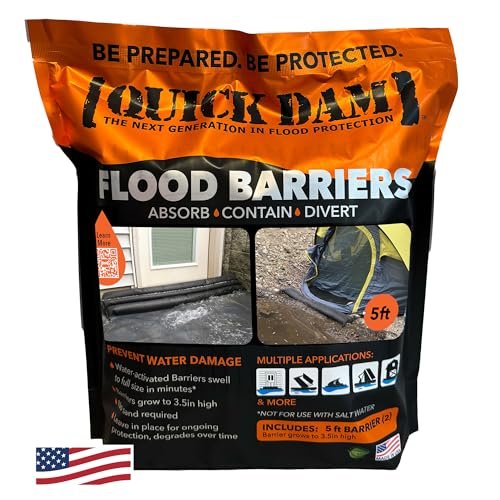
Quick Dam Water-Activated Flood Barriers Review: A Reusable Alternative to Traditional Sandbags
Flooding can happen with little warning, whether it's caused by heavy rain, overflowing drains, broken pipes, melting snow, or appliance failures. Having an effective flood protection solution ready before an emergency can significantly reduce water damage and cleanup costs.
Quick Dam Flood Barriers are designed to provide fast, temporary water control without the mess and labor associated with traditional sandbags. Instead of filling bags with sand, these barriers activate automatically when they come into contact with fresh water, expanding into an effective barrier that helps absorb, redirect, and contain incoming water.
If you're preparing your home for storm season or simply want an emergency flood protection solution on hand, here's what you should know about these water-activated flood barriers.
What Are Water-Activated Flood Barriers?
Unlike conventional sandbags that require filling, lifting, and disposal, water-activated flood barriers arrive lightweight and ready to use.
Inside each barrier is a super-absorbent material that rapidly expands when exposed to fresh water. Within minutes, the barrier increases in size, creating a low-profile wall that helps:
- Slow incoming water
- Redirect runoff
- Contain leaks
- Protect vulnerable entry points
Because they require no sand or special equipment, they are popular among homeowners, property managers, contractors, and emergency preparedness enthusiasts.
How the Activation Process Works
One of the biggest advantages of these barriers is their simplicity.
To deploy them:
- Place the barrier where water is expected.
- Allow fresh water to contact the barrier.
- Wait while it expands to its working height.
- Reposition or stack additional barriers if greater protection is needed.
Under typical conditions, the barriers reach full expansion in approximately 10 minutes once sufficient water is available.
For situations involving fast-moving water or stacked installations, pre-soaking the barriers beforehand may improve performance.
Common Uses Around the Home
Flood barriers are versatile enough to address many household water emergencies.
Popular applications include protecting:
Garage Doors
Garages are often one of the first areas to flood during heavy rain. A properly positioned barrier can help reduce water intrusion beneath garage doors.
Doorways
Exterior entry doors are another common location for water infiltration. Flood barriers can provide temporary protection during storms.
Basement Entrances
Walkout basements and lower-level doors frequently experience runoff during severe weather.
Water Heater Leaks
A leaking water heater can release significant amounts of water. Temporary barriers help redirect water until repairs can be made.
Appliance Failures
Burst washing machine hoses, leaking dishwashers, or malfunctioning refrigerators can all benefit from temporary water containment.
Construction Projects
Flood barriers are also useful for directing water away from work areas during outdoor construction or landscaping projects.
Flexible Design for Different Spaces
Unlike rigid flood panels, these barriers remain flexible.
This allows them to:
- Curve around corners
- Wrap around equipment
- Follow uneven surfaces
- Protect irregularly shaped areas
The flexibility makes them adaptable for residential, commercial, and temporary job-site use.
Dual-Chamber Design Improves Stability
The barrier features a dual-chamber construction intended to improve stability after activation.
Positioning the wider side toward incoming water helps the barrier remain in place while reducing the likelihood of rolling or shifting.
This design also makes it easier to arrange multiple barriers into longer continuous flood protection lines.
No Sand, No Heavy Lifting
Traditional sandbags are effective but require significant preparation.
Homeowners typically need to:
- Purchase sand
- Fill each bag manually
- Transport heavy bags
- Dispose of wet sand afterward
Water-activated barriers eliminate nearly all of that work.
Since they are lightweight before use, they can be stored conveniently until needed and deployed quickly during an emergency.
Long-Term Emergency Preparedness
One of the most practical benefits is their long shelf life.
Unused barriers can typically remain in storage for years when kept sealed and dry, making them an excellent addition to emergency preparedness supplies.
Many homeowners keep several on hand during:
- Hurricane season
- Spring flooding
- Snowmelt season
- Heavy rainy periods
Because they're compact before activation, storing multiple barriers requires very little space.
Can They Be Reused?
After activation, the barriers gradually dry over time.
Depending on humidity and environmental conditions, drying may take several months. Once fully dry, many barriers can swell again when exposed to fresh water, although performance may vary depending on storage conditions and overall wear.
If barriers become damaged or heavily contaminated after flood use, replacement may be the better option.
Important Usage Considerations
To achieve the best results, keep the following recommendations in mind:
- Use only with fresh water. Salt water, lime, and calcium can interfere with the absorbent material.
- Place the wider side toward incoming water.
- For deeper flooding, stack barriers according to the manufacturer's instructions.
- Pre-soak barriers when rapid deployment is required.
- Avoid cutting the barriers, as this exposes the absorbent material and renders the product unusable.
- Remove barriers after use if they are no longer needed, especially on unfinished concrete surfaces where staining may occur.
Following these practices helps maximize both performance and service life.
Advantages and Potential Limitations
Advantages
- Ready to use with no sand required
- Lightweight before activation
- Activates automatically with fresh water
- Flexible design adapts to many spaces
- Suitable for indoor and outdoor use
- Helps contain, divert, and slow water intrusion
- Long shelf life for emergency storage
- Easier to handle than traditional sandbags
Potential Limitations
- Intended for temporary flood control rather than permanent flood protection.
- Requires sufficient fresh water to activate fully.
- Not suitable for use with salt water.
- May require multiple barriers for larger flooding events or higher water levels.
Best Practices for Flood Barrier Placement
Proper placement significantly improves effectiveness.
For the best protection:
- Install barriers before water reaches the area.
- Create continuous lines with no gaps.
- Extend barriers beyond the width of doorways whenever possible.
- Stack additional barriers only if recommended for deeper water.
- Periodically inspect placement during prolonged storms.
Planning ahead often makes the biggest difference during emergency situations.
Frequently Asked Questions
How quickly do Quick Dam flood barriers expand?
Under normal conditions, the barriers typically reach full height in about 10 minutes after contacting enough fresh water.
Can they replace sandbags?
For many residential situations, they provide a convenient alternative that eliminates the need to fill and transport heavy sandbags. However, extremely severe flooding may require additional flood protection measures.
Can they be used indoors?
Yes. They are commonly used around leaking appliances, water heaters, basements, doorways, and other indoor water emergencies.
Can they be used outside?
Absolutely. They are designed for outdoor applications such as garage doors, driveways, landscaping projects, and storm preparation.
Can they be used with salt water?
No. These barriers are designed for fresh water only. Exposure to salt water or certain minerals may reduce their effectiveness.
Final Thoughts
Quick Dam Water-Activated Flood Barriers offer a practical and user-friendly solution for temporary flood protection around homes and businesses. Their lightweight design, rapid activation, flexible construction, and long storage life make them an attractive alternative to traditional sandbags for many emergency situations.
Whether you're preparing for seasonal storms, protecting a garage or basement entrance, or responding to an unexpected plumbing leak, these barriers provide a convenient way to help contain and redirect water with minimal effort. While they are not intended to replace permanent flood defenses, they can serve as an important part of a well-rounded emergency preparedness plan.