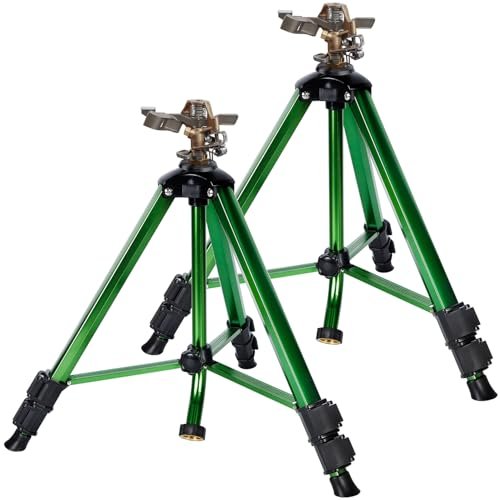
Tripod Impact Sprinkler Review: Adjustable Lawn Irrigation with Wide-Area Coverage
Watering a large lawn, garden, or landscaped area with a handheld hose can be slow, uneven, and physically demanding. A tripod impact sprinkler provides a more efficient solution by raising the sprinkler head above plants and obstacles, then distributing water across a broad area with minimal supervision.
This heavy-duty tripod garden sprinkler combines a brass impact head with an adjustable metal stand. Its height, watering arc, and spray distance can be modified to match different lawn shapes, garden layouts, and water-pressure conditions.
With an estimated coverage radius of 20 to 35 feet, compatibility with standard garden hoses, and nearly 360-degree rotation, it is designed for lawns, flower beds, vegetable gardens, greenhouses, patios, and other outdoor watering applications.
Why Choose a Tripod Lawn Sprinkler?
Ground-level sprinklers can struggle when surrounded by tall grass, shrubs, raised beds, or uneven terrain. Water may strike nearby plants or obstacles before reaching the intended area.
A tripod sprinkler raises the spray head above ground level, creating a clearer watering path. This elevated position can improve distribution while making it easier to reach over flowers, low shrubs, and garden borders.
Tripod sprinklers are especially useful for:
- Medium and large lawns
- Vegetable gardens
- Flower beds
- Newly seeded areas
- Greenhouses
- Agricultural plots
- Uneven or sloped ground
- Areas without a permanent irrigation system
Because the unit connects to a standard garden hose, it can be moved wherever watering is needed.
Heavy-Duty Brass Impact Sprinkler Head
The sprinkler uses a brass impact head designed for repeated outdoor use.
Brass is commonly used in irrigation equipment because it offers good corrosion resistance and durability. Compared with lightweight plastic sprinkler heads, a brass assembly may better tolerate frequent repositioning, outdoor exposure, and normal wear.
The impact mechanism produces the familiar pulsing spray associated with agricultural and lawn sprinklers. As water passes through the nozzle, the spring-loaded arm repeatedly strikes the stream, causing the sprinkler head to rotate across the selected watering area.
This design can provide consistent coverage while remaining relatively simple to inspect and maintain.
Adjustable Metal Tripod
The solid alloy tripod provides a stable platform for the sprinkler head. Its legs can be adjusted from approximately 16 to 37 inches high, allowing the user to select the most effective position for the surrounding landscape.
Quick-release leg clips simplify height adjustments. Once the desired height is reached, the clips lock the legs into position.
Lower Settings
A lower tripod position may be useful for:
- Small lawns
- Recently seeded areas
- Low flower beds
- Locations exposed to wind
- Areas where a lower spray trajectory is preferred
Higher Settings
Extending the tripod can help the water stream clear:
- Taller grass
- Garden plants
- Low fences
- Raised beds
- Shrubs
- Other nearby obstructions
The tripod should always be placed on stable ground with the legs spread evenly. Soft or sloped soil may require repositioning to prevent tipping.
Adjustable Watering Arc
The impact sprinkler head can rotate through almost 360 degrees. Its watering arc can be adjusted to cover a full circle or a more limited section.
Partial-circle watering is useful near:
- Houses
- Fences
- Driveways
- Sidewalks
- Patios
- Garden boundaries
Instead of spraying water over an entire circle, the sprinkler can be configured to move back and forth across the selected area.
This helps reduce water waste and keeps unnecessary moisture away from buildings, pavement, and neighboring properties.
Wide Lawn and Garden Coverage
The sprinkler is designed to cover an estimated radius of approximately 20 to 35 feet.
At maximum performance, a 35-foot radius corresponds to a potential circular watering diameter of about 70 feet. Actual coverage may be smaller depending on the installation and water supply.
Spray distance is influenced by:
- Available water pressure
- Hose diameter
- Hose length
- Nozzle condition
- Elevation changes
- Wind
- Number of connected sprinklers
- Water flow from the outdoor faucet
The recommended operating pressure is approximately 20 to 60 PSI. The sprinkler may still operate at lower pressure, but the coverage area and rotational performance may be reduced.
Suitable for Low and Moderate Water Pressure
Not every property has strong outdoor water pressure. This sprinkler is designed to operate across a reasonably broad pressure range.
At lower pressure, the spray may cover a smaller area and rotate more slowly. Increasing the pressure within the recommended range can improve distance and overall distribution.
Before assuming the sprinkler is defective, check whether the hose or faucet can supply sufficient flow. A long, narrow, damaged, or kinked hose may restrict water even when static household pressure appears adequate.
Convenient Gooseneck Hose Connection
The sprinkler includes a curved gooseneck connector intended to make hose attachment easier.
Its shape can reduce sharp bending where the hose meets the sprinkler, helping preserve water flow and minimize strain on the connection.
The inlet is designed for common U.S. garden hose fittings, generally using a 3/4-inch threaded connection. Compatibility should still be verified before purchase, particularly when using specialty hoses, international fittings, or irrigation adapters.
Built-In Filter Washer Helps Reduce Clogging
A rubber filter washer is located inside the hose connection. This component helps capture sand, gravel, and larger debris before they reach the sprinkler nozzle.
Filtering debris can reduce the risk of:
- Clogged nozzles
- Restricted flow
- Irregular spray patterns
- Stalled rotation
- Premature wear
The filter should be inspected and rinsed periodically, especially when the sprinkler is supplied by well water, rainwater storage, ponds, or older plumbing.
A small inlet filter cannot remove all fine sediment, so heavily contaminated water may require additional upstream filtration.
Practical Uses Around the Property
Lawn Irrigation
The wide spray pattern can water medium or large sections of grass without requiring a permanent underground sprinkler system.
Vegetable Gardens
Raising the sprinkler above ground level helps distribute water across rows and raised beds. Overhead irrigation may not be appropriate for every crop, so watering time and plant sensitivity should be considered.
Flower Beds
The adjustable arc allows the sprinkler to target ornamental planting areas while limiting spray onto nearby structures or walkways.
Greenhouses and Nurseries
The system may be used for general watering or light cooling where overhead spray is appropriate.
New Grass and Seeded Areas
A broad, controlled spray can help maintain surface moisture during seed germination. The pressure should be adjusted to avoid washing away soil or seed.
Patio and Outdoor Cooling
The sprinkler may provide temporary misting or cooling around open outdoor spaces, although its impact spray is stronger than a dedicated fine-mist system.
Poolside and Recreational Use
During warm weather, it can also be used for general outdoor water play or cooling, provided the ground remains safe and non-slippery.
How to Set Up the Sprinkler
The sprinkler requires only a few basic setup steps.
- Place the tripod on stable, level ground.
- Spread the legs evenly.
- Adjust the height using the quick-release clips.
- Confirm that all leg locks are securely closed.
- Inspect the filter washer inside the hose connector.
- Attach a compatible garden hose.
- Select the desired watering arc.
- Turn on the water gradually.
- Observe the spray and adjust the pressure, arc, or position as needed.
Opening the faucet gradually helps prevent sudden movement and allows time to verify that the tripod remains stable.
How to Improve Watering Coverage
Raise the Sprinkler Head
Extending the tripod can help the stream clear nearby plants and may increase effective coverage.
Remove Hose Kinks
A restricted hose can significantly reduce water pressure and flow. Straighten bends before evaluating performance.
Use a Suitable Hose Diameter
A larger-diameter hose generally delivers better flow over long distances than a narrow hose.
Avoid Excessively Long Hose Runs
Long hoses create additional friction loss. Position the sprinkler closer to the faucet when practical.
Clean the Nozzle and Filter
Sediment can reduce spray distance and interfere with rotation. Regular cleaning helps maintain performance.
Water During Calm Conditions
Wind can distort the spray pattern and carry water away from the intended area. Early morning often provides calmer conditions and lower evaporation.
Troubleshooting Common Problems
No Water During First Use
If water does not pass through the sprinkler, turn off the faucet and disconnect the hose.
Inspect the inlet filter, nozzle, and internal passage for packaging debris, dirt, or sediment. Remove loose material with a soft brush or suitable cleaning pin, then rinse the components before reconnecting the hose.
Also confirm that the faucet is open and the hose is not blocked.
Water Suddenly Stops Flowing
A sudden loss of water may result from:
- A kinked hose
- Debris inside the connection
- A clogged inlet filter
- A blocked nozzle
- Reduced household water pressure
- A partially closed faucet
Disconnect the sprinkler, rinse the fittings, straighten the hose, and test the water supply separately.
Sprinkler Rotates but Does Not Reverse
If the head moves in one direction but fails to return, the trip mechanism may be obstructed or stuck.
Turn off the water before touching the mechanism. Inspect the trip stops, spring, and moving parts for dirt, mineral deposits, or grime. Clean them with mild soapy water, rinse thoroughly, and allow them to dry.
The mechanism may be moved gently by hand to release minor binding. Avoid applying excessive force that could bend the spring or damage the stops.
Poor Spray Distance
Limited range is often caused by insufficient water flow rather than the sprinkler itself.
Try:
- Extending the tripod
- Increasing faucet flow
- Shortening the hose
- Removing hose kinks
- Cleaning the nozzle
- Checking the inlet filter
- Disconnecting other water-consuming devices
If pressure remains weak, test the faucet flow directly into a bucket to determine whether the water supply is the limiting factor.
Uneven Spray Pattern
An irregular stream may indicate partial nozzle blockage, mineral buildup, or unstable pressure.
Clean the nozzle and filter, then inspect the hose and faucet for restrictions. If the property has high sediment levels, an inline hose filter may help.
Watering Tips for Healthier Plants
Water Early in the Morning
Morning watering generally reduces evaporation and gives foliage time to dry during the day.
Avoid Frequent Shallow Watering
Established lawns and plants often benefit from deeper, less frequent watering rather than brief daily spraying. Soil type, climate, and plant species should guide the schedule.
Check Soil Moisture
Do not rely solely on appearance. Insert a finger, soil probe, or moisture meter into the soil to determine whether additional watering is necessary.
Reposition for Even Coverage
A single sprinkler may not distribute water evenly across irregularly shaped areas. Move it between zones or overlap coverage slightly.
Avoid Watering Pavement
Adjust the arc to keep water on plants and soil rather than driveways, roads, walls, and sidewalks.
Common Mistakes to Avoid
Placing the Tripod on Unstable Ground
Soft soil or an uneven surface can allow the unit to tip when the water begins flowing. Stabilize the legs before operation.
Opening the Faucet Too Quickly
A sudden pressure surge can move the sprinkler, loosen a connection, or destabilize the tripod.
Exceeding the Recommended Pressure
Higher pressure does not always produce better watering. Excessive pressure may increase misting, waste water, and stress fittings.
Ignoring the Filter Washer
A dirty inlet filter restricts flow and can make the sprinkler appear underpowered.
Leaving the Sprinkler Outside in Freezing Weather
Water trapped inside the head or fittings can freeze and cause damage. Drain and store the sprinkler before freezing conditions.
Advantages and Considerations
Advantages
- Durable brass impact sprinkler head
- Adjustable metal tripod
- Height range of approximately 16 to 37 inches
- Nearly 360-degree rotation
- Adjustable watering arc
- Estimated 20- to 35-foot spray radius
- Compatible with standard 3/4-inch garden hose fittings
- Built-in filter washer helps capture debris
- Suitable for lawns, gardens, greenhouses, and agricultural use
- Portable alternative to permanent irrigation
- Can operate across a range of water pressures
Potential Considerations
Coverage depends heavily on available pressure, hose condition, and wind. The impact mechanism may require occasional cleaning when used with sediment-heavy water.
The tripod also needs firm, level placement to remain stable. Overhead watering may not be appropriate for every plant or garden, particularly where leaf disease is a concern.
Frequently Asked Questions
How large an area can this sprinkler cover?
The stated spray radius is approximately 20 to 35 feet, depending on water pressure and installation conditions.
Does it rotate in a full circle?
The head can rotate through nearly 360 degrees and can also be adjusted for partial-circle watering.
What water pressure does it need?
The recommended operating range is approximately 20 to 60 PSI. Lower pressure may reduce spray distance and rotation speed.
What hose connection does it use?
It is designed for common U.S. 3/4-inch garden hose fittings.
Can the tripod height be adjusted?
Yes. The tripod extends from approximately 16 to 37 inches using quick-release leg clips.
Is the sprinkler head made of plastic?
The sprinkler head is described as heavy-duty brass, while the tripod is made from alloy metal.
Can it be used with well water?
Yes, but sediment may clog the nozzle or mechanism. Inspect the filter washer frequently and consider additional filtration for dirty water.
Why is the sprinkler not rotating properly?
Common causes include low pressure, debris in the impact mechanism, mineral deposits, a blocked nozzle, or incorrectly positioned trip stops.
Can it stay outside during winter?
It is better to drain, dry, and store the sprinkler before freezing weather to avoid damage from trapped water.
Final Thoughts
This tripod impact sprinkler is a practical choice for homeowners and gardeners who need portable, adjustable irrigation across medium or large outdoor areas. Its brass sprinkler head, height-adjustable metal tripod, wide watering arc, and standard hose compatibility make it suitable for lawns, flower beds, vegetable gardens, greenhouses, and light agricultural use.
Its performance depends on the quality of the water supply and the amount of available pressure. With a clean nozzle, an unrestricted hose, stable placement, and correct arc adjustment, it can deliver broad and consistent coverage without requiring a permanent underground irrigation system.
For users who want a durable garden hose sprinkler that can rise above plants and adapt to different watering zones, this tripod model offers a useful combination of reach, flexibility, and straightforward maintenance.